
Deliciously Malodorous
Notorious Chinese Stinky Tofu
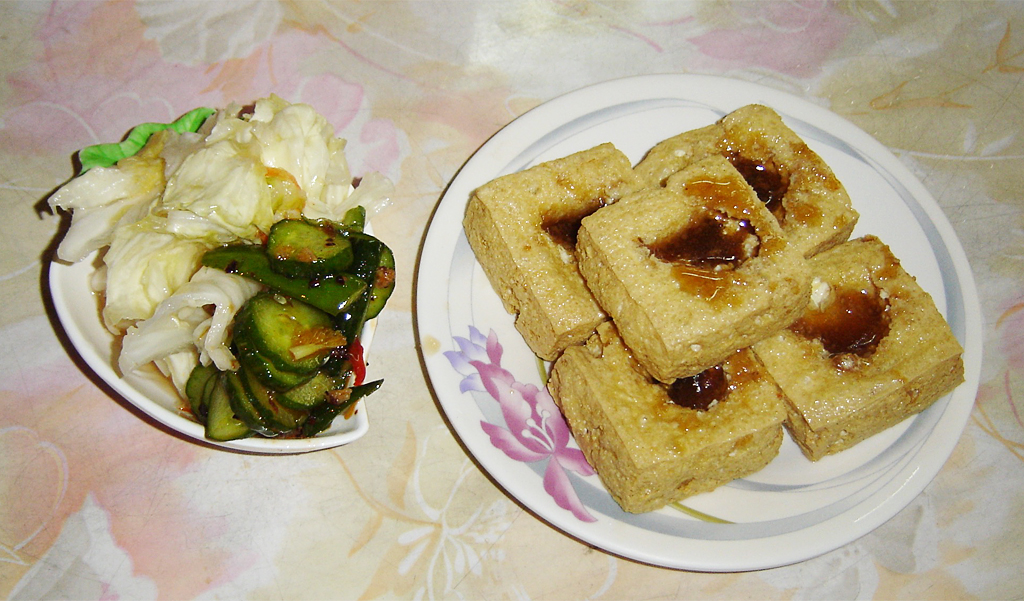
Notorious Chinese stinky tofu: love it or hate it, there’s no ignoring its extraordinary reeking power. If smells could kill … This bean curd is to China and Taiwan what the durian is to southeast Asia.
Stinky tofu is such a notorious dish that it seems an odd thing that I cannot recall my own first encounter. What I do remember though, is my father’s reaction when he first discovered it. He and my brother were visiting me in Taiwan and we were doing a brief tour of the island. We were in Tainan, the old city that in the 17th century was the centre of a brief period of Dutch occupation. We had come to marvel at the old temples Tainan is famous for.
I was unfurling my map as we walked down the street, when my father stopped in his tracks, spun around, mildly frantic, as if searching for the source of some impending disaster.
“God, what’s that smell?”
I pointed to a stinky tofu vendor, acrid smoke wafting over his pushcart.
“That’s what they call stinky tofu. Want to try some?”
In retrospect it was a silly question. My dad shot off at what was for him, an unusually quick pace, and didn’t slow down until he was safely out of range, certain he wasn’t being followed.
There is a good reason why stinky tofu is a street food. Try cooking this dish at home, and you will promptly be asked to move out; not just from the house, but from the neighbourhood. It is also known as smelly tofu. But smelly hardly seems an adequate adjective to describe the reeking power of this fermented bean curd. It is often said that stinky tofu is to China what the durian is to southeast Asia, or what Stilton cheese is to England. It is roughly comparable to the smell of a fetid, open sewer anywhere on the planet, (though I have a friend who disputes this: he reckons you would never notice the smell of the sewer with a stinky tofu stall nearby).
It is widely available in China but in Taiwan stinky tofu is especially popular. Few restaurants serve it. Those that do are likely to be specialists – if all your customers are eating it no one will be offended, right? These places usually offer a variety of stinky tofu such as deep-fried, stewed, steamed or even raw.
As it is normally eaten in Taiwan, stinky tofu is deep-fried. It should be golden and crisp, even crusty. It is served with spicy topping that nicely compliments the tofu and offsets any deep fry greasiness.
Once the cubes of tofu are fried and drained, the vendor gently makes a hole in the top of each cube with a chopstick or tongs. This lets the topping penetrate the crust. The topping is crucial to the dish. It consists of vinegar, sesame oil, shredded oriental cucumber, and pickled Chinese cabbage. The topping is finished off with a dollop each of chilli sauce and minced garlic. When you order a plate of the stinky stuff, you will probably also get a simple soup with it, gratis. The strong odour is mainly in the cooking, and it subsides quite a lot once the tofu comes out of the oil. Either that, or by then you are so saturated in its perfume that you are getting used to it.
Tofu in its basic form is invariably described as bland, so what puts the stink into stinky tofu? For this a fermentation brine is needed. Traditionally this was done in a very large unlidded earthenware jar. Vegetables and possibly shrimp are added to the brine. The whole mixture is left to fester for up to six months while micro-organisms have their way. Transforming innocuous white cubes into something terrifying, only requires about four to six hours in the brine. The tofu is then rinsed, and aged overnight in a refrigerator before it is ready to be cooked.
The stinky tofu vendor will rent stall space in a night market or set up a few folding tables by the side of a busy road, cooking from a stove set on the back of a small truck. He is a consummate marketer, with no need for extravagant signs or loud speakers to ballyhoo his wares. His promotion is direct and immediate, and gratification is nearly instant. Late in the afternoon he fires up his oil filled wok and drops in five large cubes of tofu. Within seconds a strange, highly pungent odour permeates the air, invading the nostrils of anyone within whiffing distance. Devotees, (and there are many) will be drawn by the unmistakable aroma. Everyone else will run like hell, which is basically what my dad did in Tainan.
That whole afternoon in Tainan was very frustrating. Nothing we searched for was where it was supposed to be. Instead of quaint old temples all we found to marvel at were rows of old grey houses and shabby apartment buildings. My embarrassment grew instep with my father’s annoyance. My brother’s dirty looks became more frequent. I blamed the map for being wrong, the Tainan City Government for moving all the temples; I blamed everything I could think of. I couldn’t accept the fact that we were pathetically lost, and to make matters worse, I was too proud to ask local people for help. By mid-afternoon a typical exchange of words went something like this:
Me: “But the Matsu Temple must be here! The map says …”
My father or brother: “Do you have any idea where we are?”
Me: “Just give me a minute and we’ll get back on track.”
Finally, as the sun was going down, somehow, we found ourselves back in the central district near the railway station, the faint smell of stinky tofu in the air by now something familiar and almost welcome. Footsore and exhausted we found our hotel and collapsed on the beds. By then it had dawned on me that my map had been back-the-front. What I had thought was north, was actually south. No wonder we never arrived anywhere. The only explanation I could think of, beside blatant incompetence – a possibility I dismissed immediately – was that we had been completely disoriented; sent off on a wrong trajectory by our shock encounter with that noxious stinky tofu. Yes, because of stinky tofu we had completely missed, what are the generally accepted attractions of Tainan.
During dinner, I tried once more to put a good light on the non-events of the day.
“Well, at least we got to see all kinds of things that tourists never get to see. The real Tainan!”
Thereafter followed silence and a very early night.
Though the Tainan leg of the trip had been a disaster, all in all I think my father and brother had an interesting time in Taiwan. The next day they continued by bus on to the east coast where without my guidance they seemed to find more excitement. In Hualian they joined a rafting trip on the Xiuguluan River. During the three hour paddle they capsized, and, says my brother, my father did not surface above the rapids for a worryingly long time; and they met a young woman from Singapore who took them for a gay couple, but ended up later marrying my brother anyway.
I stayed on in Taiwan and eventually developed a taste for stinky tofu. It is now one of my favourite street snacks. My brother has never since visited me in Taiwan, and it took years for my father to make a reluctant return trip. Nothing has ever been said, but I wonder if memories of stinky tofu in Tainan had something to do with that.
More information about Chinese soy products
Taiwan Stinky Tofu – Taiwanese Secrets
How To Make Stinky Tofu – Tofu Today
Soy Story: the History of the Soybean – Eating China
Soy Food in Chinese Cuisine – Eating China
Try these Chinese soy recipes
Deep Fried Tofu